Spend time now for a glorious garden all year!

The hustle and bustle of the holidays is almost over and it’s time to get back in the garden for some much needed peace and re-connection to nature! January is supposed to be a wet one this year with El Nino rains predicted, but on those dry days, get out in the garden. Time spent now will pay off later in the year with a healthy, pest and disease resistant, and of course, gloriously beautiful garden. Here are my top 5 garden tips to get your garden off to a great start in 2016.
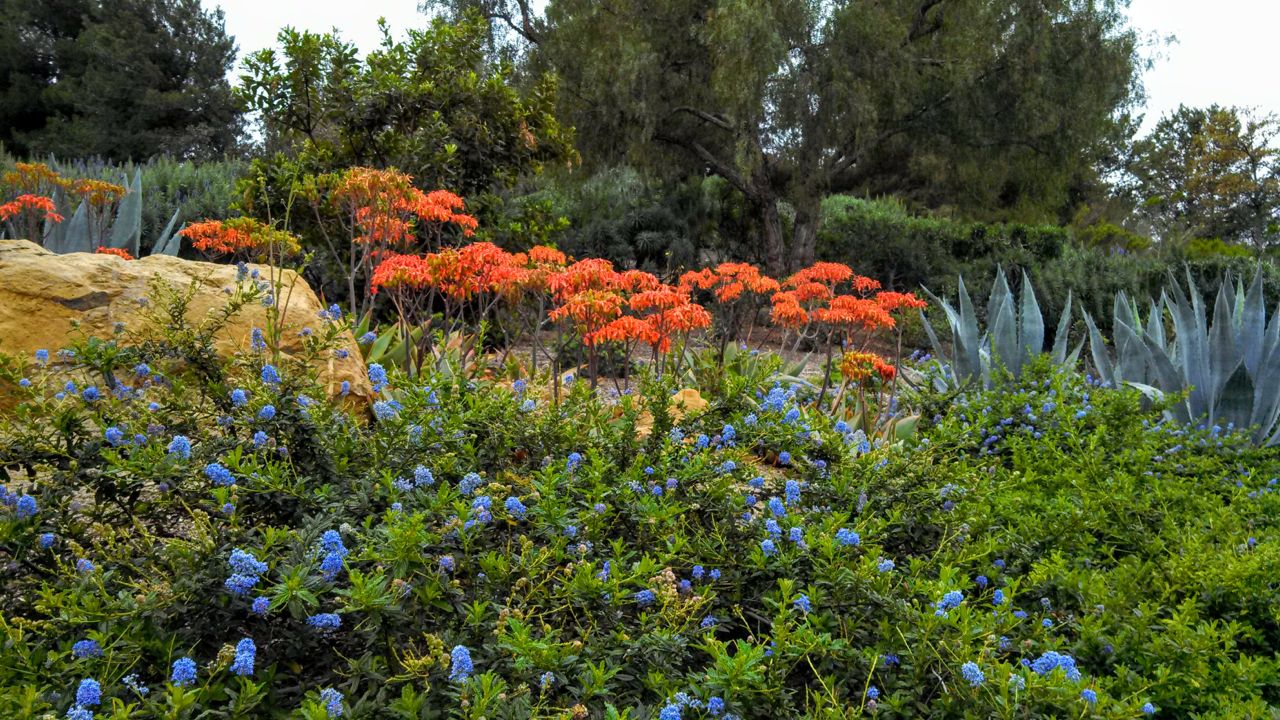
Ceanothus (blue), aloe (orange), agave (spiky) and coast live oak trees provide a colorful but water thrifty landscape.
1. Plant Natives and Water Thrifty Plants Now
Although El Nino rains are forecast for this winter, they will not necessarily bring an end to our multi year drought. Water thrifty landscapes can be colorful and just as beautiful as more water hungry plant palettes. Winter is a great time to plant natives and other water thrifty plants. Winter rains and months of moderate temperatures will help them settle in before the heat of summer (and their sometimes dormant stage) arrives. If you are not converting your entire landscape to drought tolerant plants, be sure to group plants by their water needs. For water thrifty plant selections, photos of drought tolerant landscapes. and links to numerous resources, visit the Metropolitan Water District of Southern California’s website, bewaterwise.com.
2. Dormant Spray
Deciduous fruit trees (apples, peaches, apricots, plums, etc.) and roses will be much less disease and pest prone if sprayed with a dormant spray in January. What is a dormant spray? It is a spray using horticultural oil or a fungicide that is applied when plants are ‘dormant’, or in a non-active growth stage often exhibited by the loss of their leaves. Granted, in southern California, we often do not have much of a dormant stage given our moderate temperatures. We force dormancy of roses, for instance, by pruning them in January. After pruning, or after deciduous fruit trees drop their leaves, spraying with a horticultural oil or a fungicide spray reduces pests and diseases. A horticultural oil works by smothering over wintering pests such as scales. Fungicide sprays reduce the occurrence of fungal diseases such as rust, black spot, and powdery mildew. Both horticultural oils and fungicide sprays can be found at local nurseries. A certified nurseryman can help you choose the right product for your specific plants or read the University of California Cooperative Extension article ‘What are Dormant Sprays’.

3. Mulch
If you only have time to do one of these top 5 garden tips, my vote is to apply mulch. It has multiple benefits for your garden. What is mulch? It is a layer of material placed on top of the soil. Mulch can be shredded bark, compost, straw, even shredded newspaper. In desert landscapes, gravel is sometimes used as mulch, but for most plants this heats up the soil too much. What does mulch do? Most importantly as we try to water less, it conserves moisture in the soil by providing an insulating layer on the soil surface to slow evaporation. Secondly, that insulating layer also regulates soil temperature so that soil is slower to heat up and cool down which is less stressful to plants. Another benefit of mulch, probably my personal favorite, is that it suppresses weed growth by depriving weed seeds of light so that they don’t germinate. And finally, as mulch decomposes it adds nutrients to the soil and encourages beneficial soil organisms. Use coarse mulch like shredded bark or bark chips around permanent plantings like shrubs and trees as these will decompose slowly and last longer. For areas of frequent planting like vegetable gardens or flower beds, use compost, straw, dry grass clippings, or shredded newspaper. These decompose more quickly adding nutrients to the soil each season.
Spread mulch in a layer 3 – 4 inches thick around your trees and shrubs after you have pruned, cleaned up, and sprayed. Keep mulch 3-6 inches away from tree trunks and main stems of shrubs to prevent disease organisms and too much moisture on these plant parts.

4. Plant Veggies and Fruits
With water becoming an ever more precious (and expensive) resource, why not eat the plants we water? A large garden is not necessary to grow veggies, a few large pots or wine barrels, or a couple of raised garden beds can provide more salad greens than a family can eat! What’s easy? This time of year try lettuces, spinach, arugula, snap peas, carrots, and onions. If you have a little more space, try broccoli, cabbage, beets, or strawberries. See post ‘Plant Veggies in January’ for more details.
5. Control your Controller
Last but not least of the top 5 garden tips, learn to program your automatic sprinkler timer. Although not exactly fun and exciting, it is crucial to having a successful and healthy garden during these times of reduced water allocation and tiered water pricing. On one of the rainy days we are expecting in January, dig out the manual for your sprinkler timer and figure out how to program it. If you are like me, most likely the manual is misfiled somewhere! Thank goodness for the internet, by typing in the manufacturer name and model number, you’ll most likely be able to find an online manual. Or, if you have a gardener, they are usually familiar with most models and can give you a tutorial on how to program it. If you have a great gardener, maybe he/she already takes care of adjusting the timer for you throughout the year. But in my experience, they do not do it often enough to match the water needs of each season. Not sure how long to water? Most water districts now have recommended watering times for each month. Here’s a link to my water district’s recommended watering times by month: ‘The Right Schedule’. At the very least, when it rains, manually switch off your automatic sprinkler timer. There’s nothing worse than seeing sprinklers running while or right after it’s raining!
Happy New Year!
Hi. Excellent, timely and Inspirational!!
Thank you so much.
Wonderful edition of the Newsletter. Especially love the photos. Your garden, yes? I’m going over for that salad! 🙂